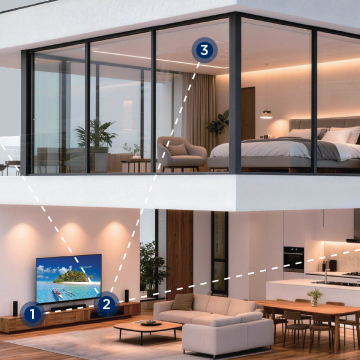
The Scenario: Complex Multi-Transmitter TV Reception
The situation
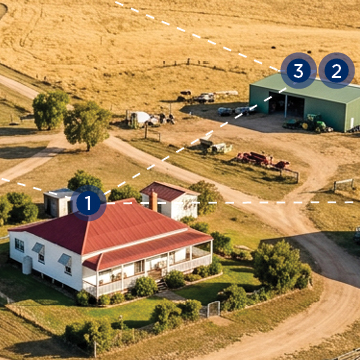
An electrical contractor is called to a large residential property, motel or apartment complex experiencing ongoing digital TV reception problems. The site sits in a difficult reception area where surrounding hills and buildings prevent reliable reception of every required TV service from a single transmitter.
To receive the complete range of channels, the installation requires multiple antennas aimed at different transmission sites.
This creates several problems at once:
- One transmitter arrives at a very strong signal level, while another is considerably weaker.
- Some wanted channels from the different transmitters are close together in frequency, making conventional filtering difficult.
- Simply combining the antennas can introduce duplicate or unwanted channels into the distribution system.
- Increasing amplifier gain to compensate for the weak channels risks over-amplifying the stronger channels and potentially overloading the system.
- Mobile phone infrastructure nearby introduces another potential source of 4G/5G LTE interference.
- Signal levels need to remain suitable for distribution to multiple television outlets throughout the property.
Why conventional amplifiers struggle.
A traditional masthead amplifier amplifies everything within its operating band. If one channel enters at 45 dBµV and another at 75 dBµV, adding 25 dB of gain does not correct the underlying imbalance—it simply makes both signals stronger.
The weak signal may improve, but the strong signal can become excessively high. Noise and unwanted signals may also be amplified.
The installer therefore does not just need more signal. They need control over individual channels.
How the 14MM-PR08-MH solves it
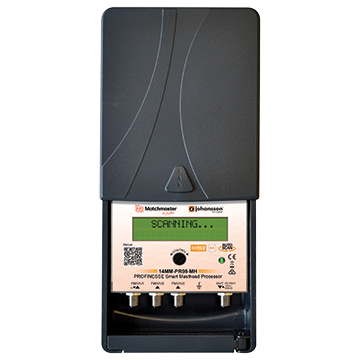
This is where the Matchmaster 14MM-PR08-MH Smart Masthead Processor becomes particularly useful.
Rather than treating the entire television spectrum as one signal, the PR08-MH can process the received TV channels individually.
The installer can connect antennas receiving signals from the different transmission sites to its available inputs. The processor can then identify the wanted DVB-T services and process them to create a controlled output.
1. Balances dramatically different signal levels
Instead of allowing the strongest transmitter to dictate the setup, the processor uses automatic gain control (AGC) to create a much more consistent output.
Weak and strong incoming channels can therefore be presented to the distribution system at a controlled 70–90 dBµV output level.
2. Combines reception from different directions
Multiple antenna inputs allow the installation to take advantage of the best available signal source for different channels, including FM and DAB/DAB+ Radio.
For example:
Antenna 1 → Main transmitter → strong VHF and Radio channels
Antenna 2 → Regional transmitter → weaker UHF channels
Antenna 3 → Alternative transmitter → additional required services
↓
14MM-PR08-MH
↓
Balanced TV channel output
↓
Distribution system → TVs throughout the property
This can turn a complicated multi-antenna installation into a single, controlled RF feed.
3. Deals with adjacent channels
A particularly difficult installation can have a strong unwanted channel sitting immediately beside a weaker wanted channel.
Broadband amplification cannot distinguish between them effectively. The PR08-MH’s channel processing and filtering provide much greater control over the wanted services, making it particularly valuable in complicated RF environments.
4. Helps prevent system overload
Instead of continually increasing amplifier gain, the installer can establish a controlled output level before the signal enters the rest of the distribution network.
That is especially important in larger MATV installations where additional amplifiers, splitters, taps and long coaxial cable runs may follow.
5. Helps combat mobile interference
Built-in LTE filtering provides additional protection against unwanted 4G/5G signals entering the television system—particularly useful where mobile services are strong relative to the wanted TV signals.
The Result
Instead of trying to solve a complicated RF problem with antennas, combiners, filters, and conventional amplifiers alone, the installer has a central point of control for the incoming terrestrial television signals.
The result is a more balanced and manageable RF system, with the required channels from multiple sources delivered at appropriate levels for onward distribution.
The problem is not always a weak TV signal. Sometimes it is too many signals at too many levels.
When an installation requires multiple antennas, receives channels from different transmitters, and has a mixture of strong, weak, and unwanted signals, simply adding amplification can make the problem worse.
The Matchmaster 14MM-PR08-MH Smart Masthead Processor gives installers the ability to selectively process and balance the required TV channels before they enter the distribution network.
Multiple transmitters. Multiple signal levels. One controlled output.
That is where the 14MM-PR08-MH turns a difficult reception problem into a professional distribution solution.